08/26/2026
The Philanthropy of Living Fully
dolly parton taught me that you can be hot and smart and live a big life without feeling bad about where you came from
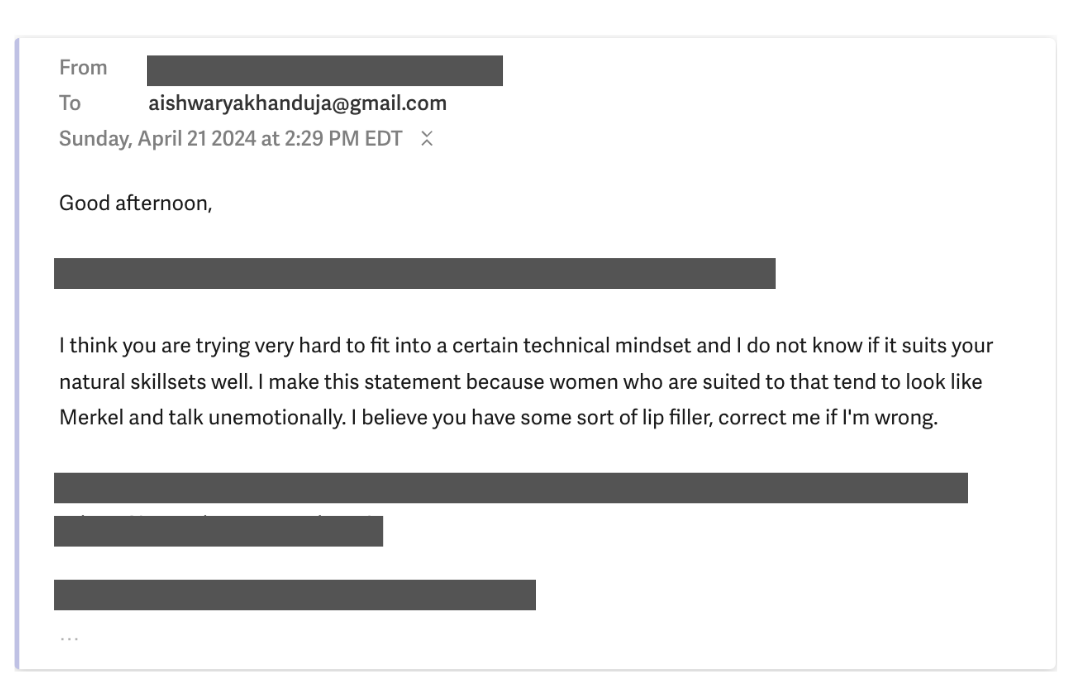
If you know me, you know my twitter name used to be Dolly Parton Stan. Dolly is a big part of why I’ve always wanted to be completely myself in the Very Serious worlds of science, technology, and philanthropy. She is proof that you can be glamorous and intellectually formidable, “unserious” in presentation and deadly serious in substance. Women are so often told to pick a lane. I’ve been explicitly told that looking feminine makes me seem less suited to technical work - that women who really belong in those worlds “look like Merkel and talk unemotionally.” At other points, I’ve been advised to uglify myself before certain meetings so I would be taken more seriously.
Last year, almost on a whim, I wrote Dolly Parton: The Unexpected Pioneer of Ed-Tech. But Dolly’s influence on me goes much deeper than that. She is one of the reasons I became interested in philanthropy in the first place.
So, in honor of her life, and of what she has taught me about generosity, power, femininity, and being entirely yourself, I started out wanting to look seriously at her philanthropy. I wanted to write a report on the dollars she donated, the programs she created, and the second-, third-, and fourth-order effects of the institutions she built, the norms she changed, and the possibilities she made visible for everyone who came after her.
While researching for this piece, I could not help but feel like I was just regurgitating what everyone else is already talking about on twitter in light of the news of her death. We already know Dolly Parton was generous. We know about the books, the hospitals, the disaster relief, the millions of dollars, the support for the COVID vaccine. When I felt into my own relationship to Dolly as a character, I realized what she really gave me was permission. And that is what I could most honestly contribute. She understood that becoming yourself is an act of creation.
Initially, I thought the permission came from Dolly having the ultimate rags-to-riches story while remaining charming, feminine, and unmistakably herself. But I think what actually moved me was that she never seemed to need to reject where she came from in order to become more. She carried it with her into rooms of extraordinary wealth and power without letting those rooms make her feel small. The hair stayed big, the accent stayed, the humor stayed, and the loyalty stayed. And as her life expanded, she kept asking what that expansion could make possible for the people she considered hers.
The philanthropy of living fully
I was born and raised in a small town in northern India, eight hours by car from the nearest international airport, and I didn’t speak fluent English until 2010 when we emigrated to Canada. I am the first woman in my bloodline to be able to drive, to live alone (especially without a man), to live in another country, to be financially independent, to attend a place like Cambridge, to travel across the world alone, and to wear whatever I want. But most importantly, I get to build a life that is illegible to the scripts I inherited. I get to hold uncertainty about what my life is supposed to look like rather than having its shape decided for me. There are parts of my life that would have been literally unimaginable to the women who came before me. Sometimes I forget how strange that makes my position that I get to inherit their world and then live completely outside its boundaries.
For a long time, I responded to that fact by wanting to turn every one of my injuries into “selfless” service. I was very good at narrating the bad starting hand. My first company came directly out of my own experience of being the first person in my family to attend a post-secondary institution in the west. I realized I wasn’t doing as well as my peers in a specialized program because of lack of access to the enormous amount of invisible knowledge about how university worked. While the diagnosis was completely true, it was not “selfless” at all. It was autobiographical and an attempt to retroactively repair my own story. This happened to me, therefore I should make sure it never happens to anyone else. You might instinctively think, “what a generous impulse!” but there is a way of remaining organized around a wound, The Wound - of needing the thing that hurt you to become useful in order to justify having gone through it.
It is not uncommon to be so identified with repairing the conditions that produced you, you never quite allow yourself to leave them. I have seen others like me make suffering the justification for ambition. You start to believe that being useful requires being a martyr.
A friend once told me something that irritated me at the time because I knew immediately that it was probably true: maybe the best thing I could do for the people I wanted so desperately to help was simply live my own life as fully as possible and let them see me do it. Like, what do you mean that I could just release the tension and pursue my actual hopes and dreams and that would be enough for my community? That this doesn’t have to mean I’m abandoning them or being indifferent to where I come from? It was not exactly easy for me to stop treating my own freedom as something I needed to apologize for or convert immediately into service.
I think Dolly understood this better than almost anyone.
She did not become less Dolly in order to become useful. She became more Dolly. She left the Smoky Mountains and became fantastically rich, fantastically famous, fantastically blonde. She wore the clothes and made the jokes and built the theme park and wrote the songs and made enormous amounts of money. Most importantly, she seemed to take genuine pleasure in having a life larger than the one she had been born into. She had fun!
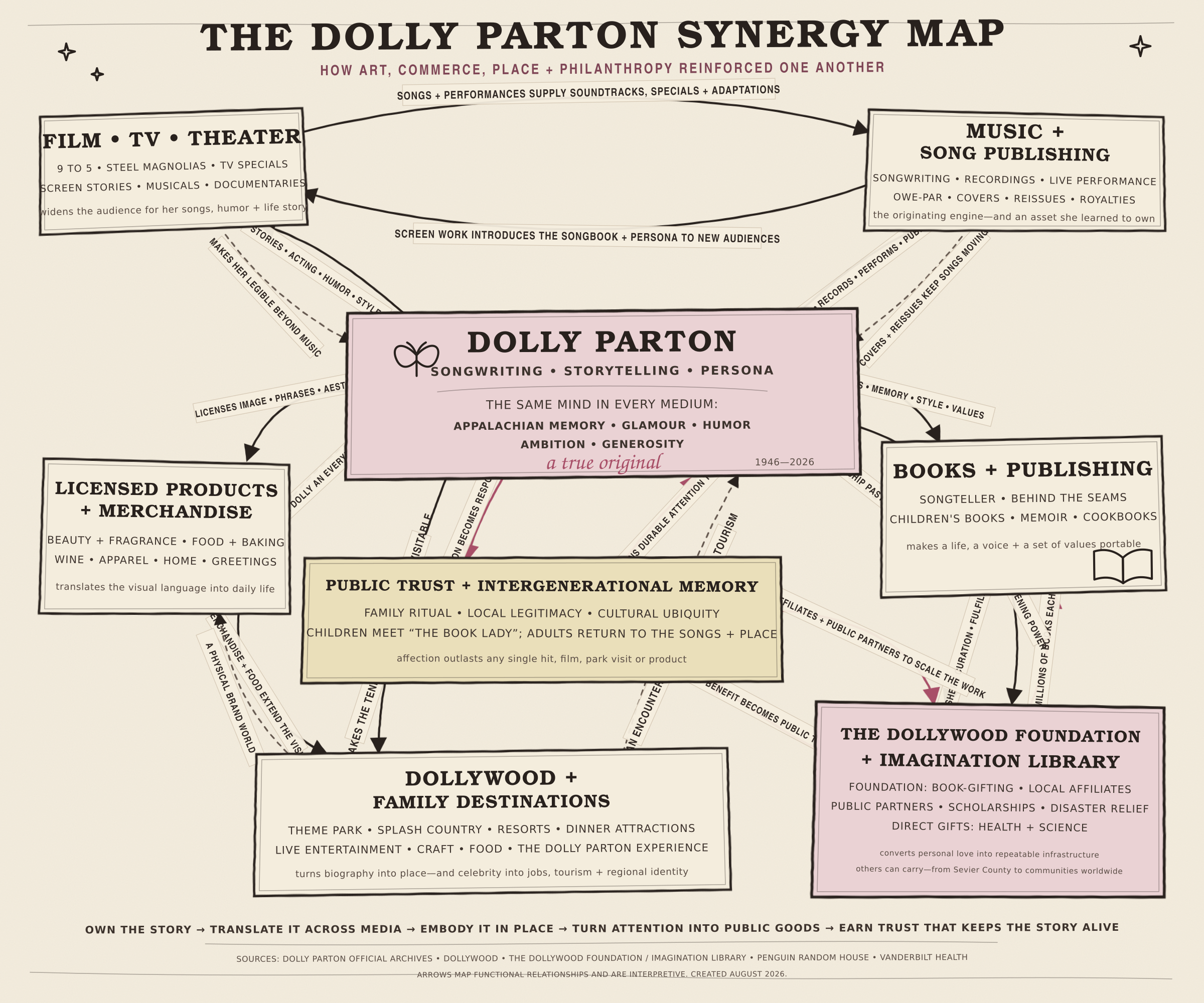
With the research I did on Dolly’s philanthropy, I had AI generate a synergy map of her work, inspired by Disney’s.
And then, crucially, she kept sending something back. She helped her community.
Seeing the fact that her generosity did not seem to emerge from guilt about having escaped poverty shifted something in me because she never ever performed deprivation in solidarity with the people she came from. She let herself have the life, while being from the place. In fact, she became profoundly of the place that made her. And because she allowed herself to receive so much from life, she had more to send back. Her philanthropy came from a deep place of spiritual abundance.
I think this is also why living a good life matters so much to me. I really do not want to escape one inherited script only to submit myself to another one. Especially this modern one where ambition has to look like #grindculture, exhaustion, and fake seriousness, which then has to be proven through self-deprivation. I want to work very hard at things I care about inside a soft life. I want leisure and beauty and friendship and travel and ridiculous clothes and long dinners and time that is not optimized toward anything. I want to do consequential work without making pain and suffering the evidence that the work is consequential. And I want to do it without any guilt or shame. Dolly made that combination feel possible too.
Maybe this is what I have learned from her more than anything else: you do not honor the people who had fewer choices by refusing your own.
In our culture, we use the word seva to describe selfless service. Dolly taught me that selfless service does not have to mean self-erasure. There is a kind of service that comes from fixing a problem. But I think there is an even deeper kind that comes from making possibility visible. Dolly made a possibility visible to me long before I had language for any of this. She showed me that I did not have to become aesthetically austere to be intelligent, emotionally detached to be powerful, ashamed of wanting money to be generous, or smaller in order to prove that I remembered where I came from. You can take your gifts all the way. You can enjoy them. You can become almost absurdly yourself. And then you can use everything that life gives you to widen the world for somebody else.
That may be the highest-order effect of Dolly Parton’s philanthropy that I care about. I’m glad for everything she funded, but what I am most grateful for is the permission structure created by watching someone refuse to shrink.
For the record, I don’t have lip filler. I do have about 200 units of Botox in my traps and regularly pay someone to stab salmon-sperm-derived polynucleotides into my face with tiny needles because I would like to be more beautiful. The email at the top was wrong about the lips, but was right about the underlying charge: I like being feminine. What I reject is the bizarre idea that this tells you anything about the quality of my mind.
Dolly understood that instinctively and never answered the accusation that femininity was unserious by becoming less feminine.
I was going to say “I want to be more Dolly!” but I think I want to be more Aishwarya!
Thank you Dolly for teaching me that one of the most generous things a person can do is live in such a way that somebody else’s life becomes more imaginable too.
—
PROOF OF LIFE 06 · © 2026
follow on twitter for new essays.
sign up for the mailing list for occasional updates.