Aishwarya’s Complexity Learning Journal
The purpose of this learning journal is to meticulously document my evolving thoughts as I delve into new knowledge in complexity science and to articulate my evolving perspective on related topics. I hope it will also help me to explore from first principles.
This will hopefully serve as a valuable tool for me to discern my areas of interest and those that do not captivate me as much. Ideally, I would like to identify a research question that is novel enough to warrant devoting several years to its exploration and resolution.
While I hope that this practice increases exposure to the field while becoming a solid resource for others to build upon, it is also supposed to be a giant doc that I can ctrl+F to find any notes as I continue to write and explore complexity.
— this learning journal is on hold for a few weeks as I explore a thesis surrounding infinite games, will update soon! —
2/28/24

I knew that John H. Holland introduced the world to genetic algorithms. When I saw that VSI’s intro to Complexity was written by him, I thought this would be the perfect way for me to begin my journey knowing that I view the world from a lens of biology (since that’s my background).
TIL
Computational complexity: the difficulty of solving different kinds of problems. The point of this subfield is to assign levels of complexity to different collections of problems. Computational complexity does not touch upon emergence (why?), so this book is mainly about systems and how they exhibit emergence.
Some thoughts: there are so many fields and subfields that exist that I (and likely many others) have never had exposure to, partly due to lack of access, and partly due to lack of curiosity. I came across MIT’s computational complexity group earlier today and realized it’s a well established group that’s been around for a while, however I found out about it today. This begs an epistemological question – that there are occasions when we may be acquainted with existing phenomena yet fail to connect the dots to give it a name. Does this imply a lack of understanding on our part? Simply because we cannot label something with the conventional terminology, does it suggest a deficiency in our intelligence?
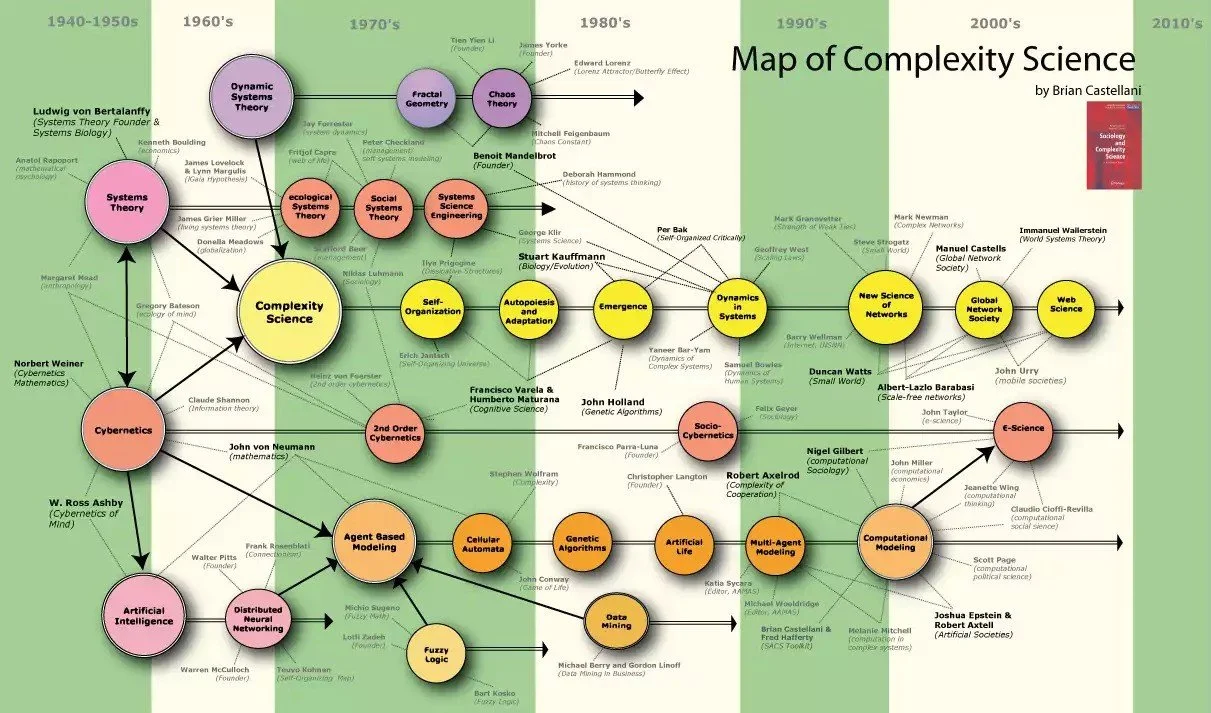
2/22/24
I found this map today showing a conceptual and historical overview of complexity science. This image is from the Art & Science Factory website. It feels like a valuable tool for me to contextualize various subthemes and construct a mental framework akin to a mind palace. I anticipate that it will help me map out the different phenomena as I broadly explore this field.
Cybernetics is super interesting and I realize I have been thinking along similar lines and did not know that the idea had a name. Essentially it seeks to uncover principles of control and communication within circular causal systems whose outputs are also inputs – like feedback systems (for me the endocrine system positive and negative feedback loops is what I’m most familiar with)
The term cybernetics was coined by Norbert Wiener (lol) in the 1940s, derived from the Greek word "kybernetes," which means "steersman" or "governor." Obviously I’m also familiar with Google’s Kubernetes (open-source container orchestration platform for containerized apps) and became curious if there is a relationship between Kubernetes and cybernetics and apparently there is, albeit indirect.
While Kubernetes itself is not directly based on principles of cybernetics, there are conceptual parallels between the two. Cybernetics is concerned with control and communication in systems. Kubernetes manages the control and coordination of containerized applications within complex distributed systems. So I guess one can draw analogies between Kubernetes and cybernetic concepts such as feedback loops, self-regulation, and adaptation. Kubernetes employs feedback mechanisms to monitor the state of applications and infrastructure, making adjustments as necessary to maintain desired states. It also enables self-healing capabilities, where it automatically detects and responds to failures or deviations from the desired state.
In essence, while Kubernetes may not be explicitly founded on cybernetic principles, its design and functionality align with many ideas central to cybernetics, particularly in terms of managing complex systems through decentralized control and dynamic adaptation. Not sure if this means anything but super interesting! I’ll probably work further on the SFI course later today.
2/21/24
My understanding of complexity science has been at a very basic level since last year when I first identified my deep interest in the field. I am now hoping to use my sabbatical to dive deeper by giving myself a curriculum and syllabus of sorts. I’ll be using resources from the Santa Fe Institute (SFI) like the complexity explorer, Melanie Mitchell’s intro to complexity book and materials, and potentially M. Mitchell Waldorp’s book as well. I also own James Gleick’s book Chaos: Making a New Science, which is also on my list. I wonder if reading about the philosophy of science (theory and reality) would actually be a good supplementary material as well. I think it would make sense to read the fundamentals before and start with Melanie Mitchell’s book and the SFI course and go from there! I’m excited to be finally embarking on this journey. I want to genuinely follow my curiosity in this field to its fullest extent in the most natural way possible and not let bureaucracy infect pure learning for the sake of it.
Today I started with Introduction to Complexity. The course is taught by Melanie Mitchell, who also wrote the book that is on my personal curriculum: Complexity: A Guided Tour. The syllabus for this course is as follows:
What is Complexity?
Dynamics and Chaos
Fractals
Information, Order, and Randomness
Genetic Algorithms
Cellular Automata
Models of Biological Self-Organization
Models of Cooperation in Social Systems
Networks
Scaling in Biology and Society
Today I got through half of #1 which covered an introduction, methodologies, and definitions. What’s interesting about the discipline of complexity itself is emerging and there is not a consistent theoretical framework on par with the major theories that frame the studies of physics/bio/econ etc.