08/04/2026
Analogue’s Portfolio Logic
moving toward interestingness
Analogue does not have a financial-return portfolio logic. The absence of required financial returns is part of the magic (logic). With the foundational belief (faith) that the problems are smarter than us, and that our job is to Listen, this is how I usually explain it to stakeholders:
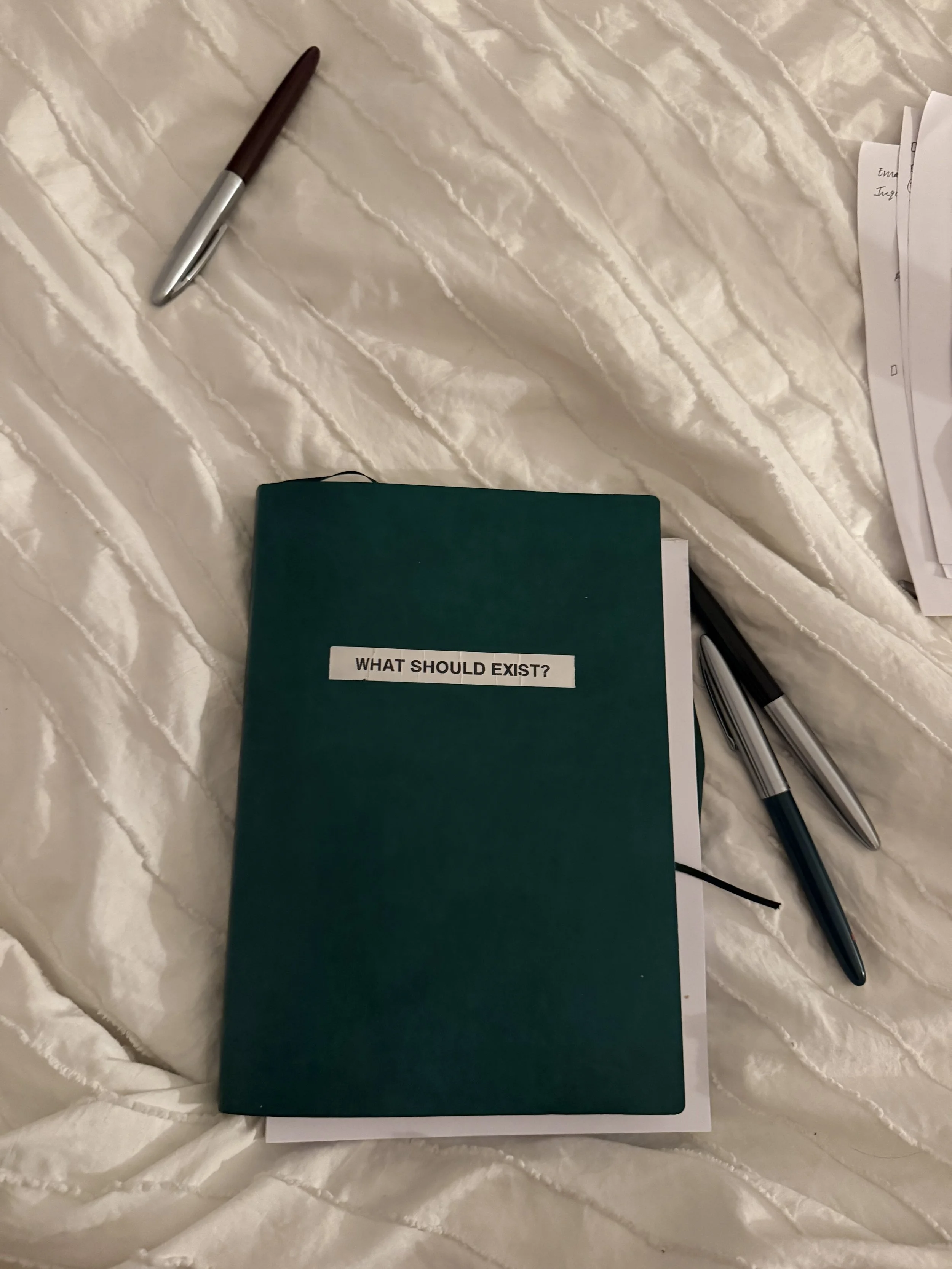
the question we ask ourselves over and over again is:
“what should exist?”
we hold forms of uncertainty that markets, universities, conventional foundations systematically reject
> “too woo for academia, too speculative for venture capital, too outside-the-box for trad philanthropy”we move toward interestingness and begin notice patterns (collect clues) in said interesting things
we support people and projects that appear to contain an important signal, even when we cannot yet fully articulate what that signal means
we notice recurring questions, methods, constraints, and institutional blind spots among projects that may initially appear unrelated
once a pattern becomes visible, we build thematic vehicles around them. for example, a fund that names the pattern, offers a provisional thesis about why it matters, and invited further work that can deepen, complicate, or disprove the thesis
expeditions, revival fund, [redacted] are never devised in advance as categories and then populated later. they emerge from what we notice in the projects
we’re not focused on diversification by subject matter. everything is concentrated around a theory of how new knowledge begins
Here are the 18 projects we funded in the first 18 months of Analogue:
What if a brain could live outside the body?
“Brain-in-vat” with Modern Perfusion Technology uses modern organ-perfusion technology to revive mid-century research on keeping a living brain alive and functional outside the body.
> This work is trying to give a brain a fake body. Without VR, you can measure whether an isolated brain is still electrically active. With VR, you can begin asking whether it can still perceive, learn, make decisions, and interact with a world. This is the literal brain-in-a-vat thought experiment becoming an actual research program.
> This sounds like science fiction until you realize people were already doing versions of it in the 1920s and the tech may finally have caught up to the ambition.
What if an enormous body of scientific knowledge has effectively disappeared because nobody translated it?
SovietRxiv (portfolio page) is building a pipeline to translate Soviet-era scientific papers into English without losing the formulas, tables, or diagrams.
See SovietRxiv and ChinaRxiv
> The OG peptide stuff is in there. And nobody else is doing it because the cost doesn’t justify the potential benefit to trad institutons. It’s also just boring and tedious but we happen to have found the people who find this interesting.
What if we grew materials instead of manufacturing them?
Material Farming grows plants in darkness on tailored nutrient diets to alter their material properties without genetic engineering or chemical dyes.
> We all learn that plants need sunlight. Filipe’s bet is that photosynthesis is only one mode of plant life, and that plants may still “remember” how to live on sugar.
> His proof is a dark box with a thermal camera watching them grow through the heat they release. If he is right, we could grow food where sunlight is scarce - or materials whose properties are baked in from the beginning.
What if chronic pain is sometimes a mistake the brain has learned to keep making?
Debug Your Pain treats certain forms of chronic pain as a learned prediction rather than evidence of continuing tissue damage.
> I’m really interested in the Adlerian view of things (versus Freudian) and this scratches that itch. The ideas of procedural learning and existential kink also keep coming up in my personal somatic therapy sessions.
What actually makes people trust one another?
Conditions of We studies when trust forms, holds, and breaks inside real organizations, then turns those findings into practical protocols.
> Every ambitious project eventually becomes a coordination problem, yet we have far more theories of strategy than practical knowledge about how trust is created, maintained, repaired, or lost.
> As capital concentrates in fewer hands (third wave!!!), I think the ability to coordinate may be the biggest wedge left for everyone else.
> I’ve also become everything-is-a-coordination-problem pilled. Thanks Ivan. (if you’re working on anything surrounding coordination or cooperation, please hit my line.)
What if vitality begins in the space between cells?
The Space Between uses microscopy to study blood-cell clumping and test whether interventions such as grounding, sauna, infrared light, and reduced EMF exposure change blood flow.
> The claims around structured water, grounding, and EMFs are exactly the kind people either believe or mock without testing
> We mostly want someone to put the blood under a microscope and look. Karol spent a lot of time due-diligencing this one. A scientist I really really respect and admire has recently become interested in structured water too so I took that as a sign to approve this project.
What if mathematics never became less visual, but simply changed what counted as a diagram?
Shift in Diagrammatic Reasoning in Topology reconstructs how visual reasoning in topology (20th century) changed during the invention of category theory and commutative diagrams.
> Moved from geometric drawings to commutative diagrams (networks of arrows showing how mathematical objects relate) → category theory.
> The possibility that a supposedly abstract turn in mathematics was actually a transformation in visual reasoning is very interesting to me. And that recovering it could matter for how AI learns to reason.
> Like math is still thinking in pictures but just recoded into a more abstract form - partly history project and partly a clue for AI, which can manipulate mathematical symbols but may be missing the visual intuitions that originally made those symbols meaningful.
What if your blood vessels are part of how you think? What if tension is the body thinking?
Theory of Vasocomputation argues that felt bodily tension is a form of computation performed by the vasculature, connecting neuroscience, phenomenology, and Buddhism.
> Tracing different states of consciousness into what’s happening physiologically in the vasculature. Maybe the vasculature participates in cognition by physically encoding unresolved prediction error as the felt tension (lesions) we carry in the body.
> I am always drawn to theories that collapse distinctions we treat as obvious: mind and body, thought and feeling, computation and physiology.
> If the theory holds, it could connect trauma, conscious experience, and contemplative practice through the same underlying process.
What if we learned to speak to biological intelligence instead of building a simulation of it?
Homunculus develops interfaces for communicating directly with living biological systems.
> While everyone is racing to build intelligence in silicon, biology has been solving problems of learning, adaptation, and coordination for billions of years. I’m interested in the possibility that the more radical path is not to simulate intelligence, but to develop interfaces with the intelligence already present in living tissue.
> I’ve been interested in this for a long time. I wrote a bit about this in From Physics Envy to Biology Envy
What if the body can process information in ways modern biomedicine has no language for?
Chinese Somatic Science reconstructs China’s nationwide 1979–1999 research program into anomalous bodily phenomena, including extrasensory perception.
> China spent twenty years running a nationwide research program on anomalous bodily phenomena.
> Children who could “read” Chinese characters without seeing them - through an ear, a fingertip, or a folded piece of paper held in the hand.
> The evidence was contested, but the research frame is irresistible to us because it preserves a moment when researchers were willing to ask whether the body could receive and process information through channels modern biomedicine has no language for (little bit Rupert Sheldrake morphic resonance vibe?)
What if living neurons could play games?
Benchmarking Synthetic Bioengineered Intelligence uses multiplayer games to train and benchmark living neuronal cultures connected to electronic hardware.
> We know how to benchmark a language model; Jenn and Chloe are trying to invent the benchmark for an intelligence we do not yet know how to communicate with.
> This revives the older Artificial Life tradition of creating the conditions for intelligence to emerge rather than programming behavior from the top down. Before we can benchmark a new kind of intelligence, we first have to invent a shared language with it (The Wittgensteinian in me!)
What if DNA could learn?
DNA Chemical Computing / Molecular Inference engineers DNA and RNA molecules that interact through chemistry to perform tasks like classification and inference, turning an older proof-of-concept into a repeatable engineering system.
> This field had an exciting first life and then stalled on the annoying physical reality of molecules. We now have better simulation and sequence design, which may finally make the old dream engineerable.
> More biology-coded: DNA is usually treated as biological storage, but it can also compute (!) and even carry out something resembling learning (through chemical reactions). This field generated some real excitement and then stalled because molecules are very messy: they leak, cross-react, and refuse to behave like clean software.
> Abhinav is revisiting it now that AI and sequence-design tools may finally be good enough to work with that mess.
What if your rare medical problem has already been solved in an obscure Reddit thread?
Folk Science finds and organizes patient-reported medical knowledge from forums, blogs, and other informal corners of the internet.
> Patients often become the only people motivated enough to integrate every strange clue about their own condition, but almost none of that knowledge makes it into the formal record.
> Could be huge for rare disease. Especially with AI for science tooling (this coming soon too!)
What if the organization of research determines what researchers are able to know?
Forgotten Forms of Inquiry studies overlooked artistic research collectives to recover the organizational methods that allowed them to hold uncertainty, challenge dominant ways of knowing, and produce work that conventional institutions could not.
> I think of these collectives (sceniuses?) as forgotten institutional ancestors. Sort of like proof that strange knowledge often needs a strange container, and that metascience has as much to learn from artists as it does from scientists.
> Second Renaissance was my precursor to studying coordination. I’m still scouting for a vehicle around coordination and cooperation in case anyone is interested (email me)
What if the universe is waking up to itself?
The Library of Consciousness is an open archive of more than 1,000 rare texts on consciousness and evolution, organized around the idea that the universe is becoming aware of itself.
> I love an archive with a thesis, especially when the thesis is this ambitious and the archive contains a thousand strange texts that no normal library would ever put beside one another.
> Discovery and exposure are big for novelty searching.
What if the most interesting culture on the internet is being made by people with no names?
Niche Design vol. 2 is a design-culture zine studying niche communities and pseudoanonymous online accounts as a new form of authorship.
> Pseudoanonymity lets people build a body of work without turning the self into the product, and I think that is becoming an increasingly important cultural form. Compound VC has a partner that’s a pseudoanonymous twitter account.
> We scout for Expeditions through pseudoanonymous accounts on twitter as well :) I also love alt accounts. Something something tumblr. Something something cozy internet.
What if someone you trusted actually read all the longevity research for you?
Live Longer World reviews health and longevity research to separate useful interventions from hype and snake oil.
> The longevity internet is a perfect mixture of real science, snake oil, and the extremely human desire not to die, so I value anyone willing to parse it honestly. Aastha also tests things out in the most folk science way which we love.
What if we could watch ideas take root in real time?
Open Memetics develops research and tools for understanding how ideas spread online and how groups use them to coordinate.
> “What is the anatomy of an internet argument and how are social movements formed?” attracted me to this project. A lot of things in economics seem to be downstream of social movements. I’m particularly interested in labor markets.
> The internet is a cognitive Wild West, and Omar treats memes as infrastructure through which groups learn, coordinate, and sometimes lose their minds.
From Analogue Press:
Other:
Analogue’s Curriculum
Our ecosystem projects: analoguegroup.org/ecosystem-projects
Karol (expeditions director)’s methodology on interestingness: https://expeditions.earth/methodology
Writing about modern philanthropy, patronage, and funding:
Trying to Predict Impact Often Prevents the Highest Impact: The Paradox of Progress
Seeing Like a Gardener: A New Framework for the Public Funding of Science
Special thanks to Andy Weissman who urged me to write this piece.
PROOF OF LIFE 03 · © 2026
follow on twitter for new essays.
sign up for the mailing list for occasional updates.